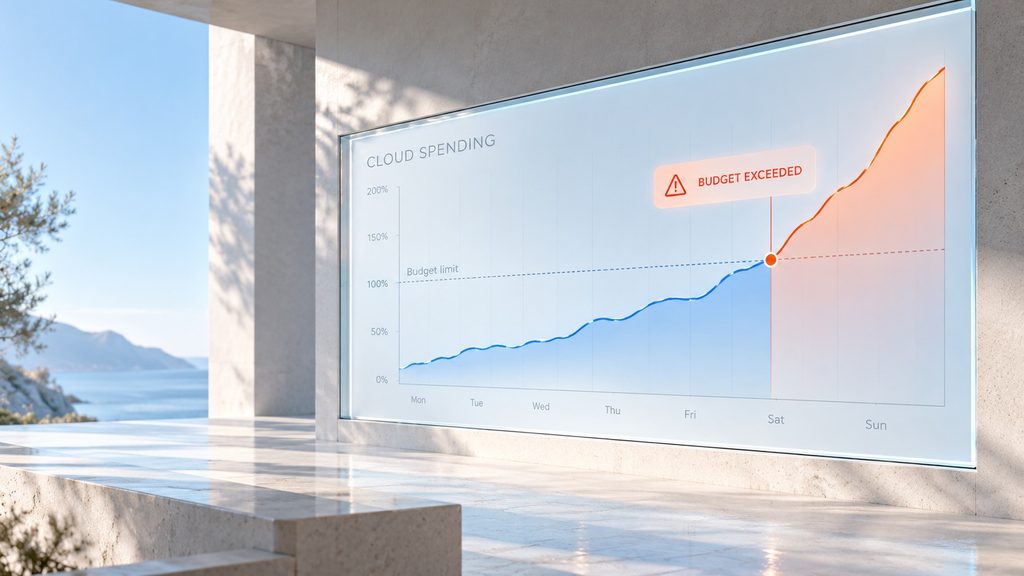
Cloud budget alerts can warn you that spending is increasing, but an alert does not necessarily prevent another dollar from being charged. A workload can continue consuming resources while billing data is processed, a threshold is evaluated and an operator decides what to do. Some cloud services offer enforceable spending caps, but their coverage and behavior differ. The architecture decision is where to use financial monitoring, where to restrict resource consumption and where stopping a workload would create more damage than allowing a temporary cost overrun.
The distinction matters for production applications, development environments, large data-processing jobs and usage-based APIs. All can generate unexpected costs, but they cannot safely share the same emergency response.
Use cloud budget alerts to detect financial deviations. Use technical guardrails or supported spending caps to constrain consumption. Decide separately which workloads can be stopped automatically.
- Why cloud budget alerts are not spending limits
- The hidden cost is the time between detection and control
- A hypothetical cost incident: the alert worked, but the safeguard failed
- Four layers of cloud cost protection
- 1. Budget reporting: visibility and accountability
- 2. Anomaly detection: recognize unusual behavior
- 3. Technical guardrails: constrain consumption before billing
- 4. Spend enforcement: stop eligible usage deliberately
- Automatic shutdown can become a reliability incident
- Design different cost boundaries for different workloads
- Disposable environments
- Production workloads with graceful degradation
- Critical production systems
- The economic fault domain is an architectural choice
- Test the controls before an expensive incident
- The decision: alert on money, constrain behavior
- Explore the decisions behind sustainable cloud systems
Why cloud budget alerts are not spending limits
A budget defines a financial expectation. An alert reports that actual or forecasted spending has crossed a configured threshold. Neither function necessarily changes the workload creating the cost.
AWS explicitly warns that charges may continue accumulating before and after an AWS Budgets notification because resource usage and billing records are not instantaneous. Its budget documentation distinguishes notification timing from the underlying consumption.
Microsoft’s Azure Cost Management documentation similarly states that budget notifications do not themselves interrupt resources. Azure cost and usage data is typically available within 8–24 hours, while budget evaluation occurs every 24 hours.
Google Cloud distinguishes alerts-only budgets from spend-cap budgets. Its alerts-only budgets notify users about spending and can support programmatic responses, but do not automatically limit usage.
This is an important architectural boundary. The billing system observes consumption. The application and infrastructure are responsible for generating it. Unless a separate enforcement mechanism connects the two, the warning has no direct effect on consumption.
A financial threshold is an observation boundary. It becomes an enforcement boundary only when a supported control is configured to change future consumption.
The hidden cost is the time between detection and control
An overspending incident has a financial exposure window. It starts when unexpected consumption begins and ends when that consumption is successfully reduced or stopped.
A simplified analytical model is:
Additional exposure ≈ incremental cost rate × time until effective intervention.
The time interval may include billing-data delay, budget evaluation, notification delivery, investigation, approval and the actual execution of corrective action.
In practice, costs are rarely perfectly linear. Resource pricing, minimum billing intervals, credits, committed usage, delayed records and overlapping services complicate the calculation. The model is a planning tool, not a substitute for an invoice or a measured cost report.
Still, it reveals an important design problem: the danger is not only how rapidly an application consumes resources. It is how long that consumption can continue without an effective control.
AWS provides a concrete reason to care about that delay. Its Cost Anomaly Detection documentation explains that the service evaluates processed billing data approximately three times daily and that the underlying Cost Explorer data can be delayed by up to 24 hours.
An individual anomaly notification can arrive promptly after detection while still describing usage that occurred many hours earlier.
A monitoring design that treats “immediate notification” as “immediate detection of usage” confuses two different clocks.
A hypothetical cost incident: the alert worked, but the safeguard failed
Consider a hypothetical development account used for batch data processing.
A configuration change starts additional workers that generate $90 per hour of incremental, otherwise avoidable cloud charges. The account has a budget alert, but no predefined worker-count limit or automatic job timeout.
Assume the following illustrative timeline, measured from the point at which the unexpected additional consumption begins:
| Stage | Illustrative elapsed time | What happens |
|---|---|---|
| Unexpected consumption starts | Hour 0 | Additional processing workers begin running |
| Financial signal becomes actionable | Hour 12 | The spending deviation reaches the responsible team |
| Operator investigates | Hour 13 | The unnecessary workload is identified |
| Corrective action takes effect | Hour 15 | Additional workers are stopped and verified |
Under the simplified assumptions, $90 multiplied by 15 hours produces $1,350 of incremental exposure.
These durations and amounts are hypothetical. They are not AWS, Azure or Google Cloud measurements, and the calculation excludes any charges that might continue after the workers stop.
The important outcome is that the financial alert can function as configured while still failing to prevent substantial additional spending.
Now consider a different architecture. The same workload has an execution deadline, a maximum worker count and an authorized policy that rejects additional processing beyond its allowed resource envelope.
Such controls can limit exposure earlier because they act on application or infrastructure behavior rather than waiting for finalized cost information. They do not guarantee a precise currency limit, and they may have their own failure modes, but they reduce reliance on a delayed billing signal.
Estimate the maximum additional consumption that can occur before corrective action takes effect. If that exposure is unacceptable, move the control closer to the workload.
Four layers of cloud cost protection
A useful cost-control architecture separates visibility from containment. The layers below address different problems, and stronger enforcement is not automatically appropriate for every workload.
| Control layer | Primary purpose | Important limitation |
|---|---|---|
| Budget reporting | Show spending against planned amounts | Does not necessarily change consumption |
| Anomaly detection | Identify unusual cost behavior | Depends on data freshness and detection rules |
| Technical guardrails | Restrict workload behavior, capacity or resource creation | Do not translate directly into an exact currency cap |
| Spend enforcement | Pause or constrain eligible consumption when a defined condition is met | Coverage, timing and operational side effects vary |
1. Budget reporting: visibility and accountability
Budgets are valuable for planning, owner accountability and recognizing deviations from expected spending.
A team can compare actual costs with approved project budgets, investigate unexpectedly expensive services and decide whether consumption remains justified.
This works well for workloads where a delayed decision is acceptable, such as an established service with relatively predictable demand.
But a budget alone is a weak safeguard for rapidly multiplying resources or unbounded batch execution.
2. Anomaly detection: recognize unusual behavior
Anomaly detection adds context. Instead of only comparing costs with a fixed monthly threshold, it attempts to identify behavior that differs from expected spending patterns.
For AWS, detected anomalies can be organized around services, linked accounts and other supported dimensions. Notifications can be configured with different thresholds and delivery frequencies.
Anomaly detection is particularly useful when the budget is large enough that a small but significant workload regression might not immediately cross a monthly threshold.
However, an anomaly model is only as useful as its visibility, coverage and data freshness. Newly introduced services may also need sufficient history before meaningful anomalies can be detected.
3. Technical guardrails: constrain consumption before billing
Technical guardrails operate closer to the source of usage.
Examples include limiting worker concurrency, setting maximum job execution times, restricting resource provisioning, controlling API request rates and bounding the number of environments that automation can create.
These controls can be effective because they do not depend on waiting for a billing report.
They also require architectural judgment. A quota that limits batch workers may prevent runaway processing, but the same restriction could cause a production backlog during legitimate demand.
Resource ceilings therefore need to be derived from expected workload behavior, not copied from arbitrary cost targets.
Cloud.Rich’s discussion of when autoscaling should stop adding replicas addresses a related engineering problem: increasing capacity can stop improving the system even while infrastructure consumption continues growing.
4. Spend enforcement: stop eligible usage deliberately
Some provider mechanisms can take actions when spending conditions are met.
AWS supports budget actions that can apply IAM policies or service control policies, and can target certain EC2 or RDS instances. Actions may be automatic or require approval.
Google Cloud documents spend-cap budgets for eligible services. These caps use estimated gross costs and can pause new eligible service usage after the configured threshold is exceeded. Their scope is limited, enforcement is not instantaneous, and charges can exceed the amount.
Microsoft Azure supports integration between budget notifications and action groups for automated responses. Its ordinary budget evaluation remains based on delayed cost information.
The engineering question is not simply whether the cloud provider supports automated cost control. It is whether the selected action reliably restricts the intended consumption, when the action becomes effective and which business operations it might interrupt.
Automatic shutdown can become a reliability incident
A developer sandbox and a payment-processing service should not have identical financial protection policies.
For a disposable test environment, stopping expensive workloads may be acceptable. The cost of interruption is often low, provided that test data and shared dependencies are handled appropriately.
For a production service, an automated shutdown may make the application unavailable, interrupt processing or violate commitments that are more important than a temporary spending overrun.
A spending cap on an API can also affect requests that the application treats as essential. Even if the financial control performs exactly as intended, the service may experience errors after usage is paused.
This creates a second risk model:
Financial loss from continued consumption versus operational loss from automatic restriction.
The decision depends on whether the workload can tolerate interruption, whether work can be retried, whether partially completed operations remain consistent and whether an operator can safely reverse the action.
A cost-control action can be financially successful and operationally harmful. Evaluate its failure consequences before enabling automatic enforcement.
Design different cost boundaries for different workloads
Start by dividing workloads according to the business consequences of an automatic restriction.
Disposable environments
Ephemeral experiments, temporary analytics jobs and noncritical test workloads are good candidates for strict execution limits and automatically enforced consumption boundaries.
Typical safeguards include environment expiration, resource-count ceilings, execution deadlines and cleanup automation. Where a provider supports a suitable spend cap, it can supplement these controls.
The baseline is restrictive because the business normally values cost predictability more than continuous availability for these workloads.
Production workloads with graceful degradation
Some workloads can reduce expensive optional activity without stopping essential operations.
A service might temporarily reduce noncritical batch processing, lower analytics concurrency or defer optional background work while continuing to serve customer transactions.
This approach needs explicit priorities. A workload should not silently drop essential events or abandon accepted operations merely to reduce consumption.
Backpressure, bounded queues and retry policies must also be considered, because deferred work does not disappear. It can create later processing peaks.
Critical production systems
For systems with strict availability or correctness requirements, abrupt billing-triggered shutdown is usually a poor default.
Prefer early warning, resource governance, workload-specific limits, predefined escalation paths and reviewed remediation.
Automated controls can still be appropriate for obviously unsafe activities, such as unauthorized resource creation or workloads exceeding a tightly defined operational envelope. But the protected business function should remain explicit.
The safest baseline is often a combination of financial alerts and technical constraints, with deliberate human approval for actions that could interrupt critical service.
Use automatic consumption limits for workloads with acceptable interruption costs. For critical systems, protect the essential transaction path and enforce narrower resource-level boundaries.
The economic fault domain is an architectural choice
Failure domains are normally discussed in the context of availability. The same reasoning can help isolate unexpected consumption.
If one experimental workload can create expensive resources across an entire shared production account, its potential financial impact is larger than the experiment itself.
Separating projects, accounts, permissions and provisioning policies can reduce that exposure. A sandbox can have stricter creation rights and cleanup rules than production. A batch-processing platform can enforce concurrency limits without changing the limits of customer-facing APIs.
But isolation is not free. More accounts and projects introduce governance overhead, identity administration, billing allocation, networking design and deployment responsibilities.
The objective is not to create a separate account for every workload. It is to make the boundary of permitted consumption align with the authority and business purpose of the workload.
This complements Cloud.Rich’s analysis of on-demand versus committed cloud capacity. A lower unit price improves the economics of expected usage, but it does not automatically prevent unexpected resource creation or unbounded consumption.
Test the controls before an expensive incident
A cost-control policy is incomplete until its behavior is understood.
For an alerts-only mechanism, use supported test methods and confirm notification routing, ownership and escalation. Do not create real unexpected charges solely to test billing behavior.
For technical guardrails, verify that requests exceeding permitted concurrency, capacity or resource creation are rejected or queued as designed.
For an automatic action, test in an isolated, low-risk environment. Check the action’s permissions, trigger scope, failure behavior and reversal process.
The most important evidence is whether the control affects only the intended workload.
A policy that cannot be reversed safely or that unintentionally affects shared infrastructure may introduce a larger operational risk than the cost incident it was designed to contain.
Regular review is necessary when pricing models, workload traffic, service limits or the provider’s available enforcement capabilities change.
The decision: alert on money, constrain behavior
Begin with a clear owner and budget for each significant workload. Measure expected usage, identify expensive dimensions and enable appropriate cost visibility.
Next, determine which workloads could accumulate unacceptable additional costs before a billing-based notification becomes actionable. For those workloads, introduce controls that bound execution, capacity or provisioning independently of billing-data latency.
Use provider-supported spend caps where their eligibility, enforcement timing and interruption behavior match the workload. Avoid treating broad automated shutdown as the default solution for production.
Finally, verify both sides of the design: that unnecessary consumption can be constrained, and that essential service behavior remains correct when a control activates.
Budget alerts tell you that spending has changed. A well-designed cost-control architecture determines how much additional consumption is permitted before anyone needs to act.
Explore the decisions behind sustainable cloud systems
Connect financial controls with infrastructure governance, scaling behavior and operating cost.
Cloud strategy, architecture and infrastructure decisions explained without vendor noise.